
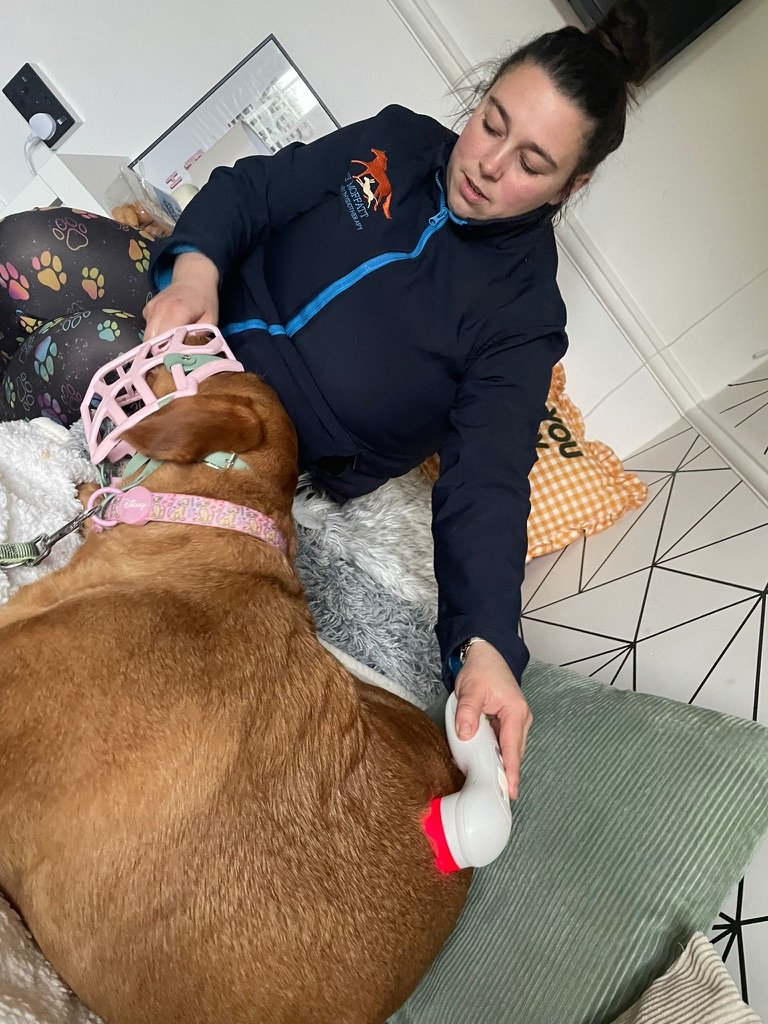
Behavioural pain assessment
Our Canine Behavioural Pain Assessment service uses expert evaluation techniques to identify and manage pain in dogs, ensuring they receive the care they need for optimal well-being. We work alongside your behaviourist and veterinarian to ensure the best possible care for your dog. We can perform this session completely hands-off if your dog needs space.
Scientific research has shown that pain in dogs is frequently the "hidden" driver behind common behavioural problems. A landmark review estimated that up to 80% of behavioural cases referred to specialists involve some form of undiagnosed pain (Mills et al., 2020).
Give Your Dog a Voice with our Behavioural Pain Assessment
Behavioural problems are rarely just a training issue, they are very often a sign that your dog is hurting. Our Canine Behavioural Pain Assessment connects the dots between medical checks and everyday behaviour. We work directly with your vet to find hidden pain and create a gentle, step-by-step plan to help your dog feel happy and comfortable again.
Don't wait for pain to become your dog's normal. Help your dog today by booking an assessment with our team.
My Approach is different and tailored to YOU and YOUR dog.
We can run these sessions entirely hands-off from a comfortable distance, ensuring your dog stays relaxed, safe, and stress-free throughout.
What to Expect in Our Assessment
1. Home Environment Evaluation: Small adjustments to your dog’s everyday surroundings can dramatically lower stress and protect them from physical discomfort. We review your home setup to recommend simple fixes, such as non-slip flooring to prevent slips and joint strain, restful sleeping zones clear of drafts and busy hallways, raised feeding stations to take strain off the neck and spine, and home access checks for stairs and furniture that may be filling your dog's stress bucket.
2. Personalised Exercise & Activity Plan: When it comes to exercise, more is not always better. We evaluate your dog's daily routine to prevent physical and mental burnout from over-stimulation, replacing excessive walks with calming brain games and enrichment. We also identify subtle compensatory strain where your dog off-loads a sore limb, providing custom exercises with video support so you can confidently guide your dog's recovery at home.
3. Movement & Gait Analysis: By watching how your dog walks, trots, and turns in natural scenarios, we spot subtle signs of pain that often show up as "bad" behaviour. We observe speed transitions for uneven steps, compare soft versus hard surfaces to uncover joint or nerve sensitivity, and analyze turns and weight distribution to see how your dog's spine flexes and whether they are leaning away from a sore hip or leg.
4. Gentle Handling & Palpation: If your dog is comfortable being touched, we use a soft, low-stress handling approach to build trust before feeling for areas of discomfort. Using gentle touch, lighter release techniques, and subtle limb positioning, we assess their physical state without causing distress, ensuring this step is only taken if it is entirely appropriate for your dog.
Every assessment concludes with a comprehensive report sent directly to your team of veterinary professionals, detailing precisely how your dog's physical discomfort may be driving their behaviour.
Understanding Hidden Pain & Behaviour
Scientific research shows that up to 80% of behavioural cases referred to specialists involve some form of undiagnosed physical pain (Mills et al., 2020). Because dogs naturally hide weakness, discomfort rarely presents as a simple limp, instead manifesting as subtle shifts in personality, mood, and daily movement patterns.
Patience, Mood & Emotional Shifts: Pain significantly lowers a dog's tolerance, leading to sudden touch sensitivitywhere they flinch, growl, or snap when their lower back, hips, or paws are petted. It frequently triggers sudden outbursts and reactivity in dogs over a year old, drives resource guarding of beds and toys out of feeling defenceless, causes a sudden fear of loud noises due to the painful muscle tension noise-fright creates, and leads to clinginess or isolation as well as poor sleep at night.
Posture, Movement & Self-Soothing Habits: Physical pain forces dogs to alter how they move and cope. You may notice a "lazy sit" where your dog slumps to one side to take pressure off their hips, hesitation at stairs or cars, and tense facial expressions like furrowed foreheads or tight eyes. Pain also drives repetitive self-soothing behaviours, including licking or chewing paws and joints to cope with nerve tingling, or eating non-food items like grass, dirt, or carpet to soothe gastrointestinal discomfort.
Behavioural problems are rarely just a training issue—they are very often a sign that your dog is hurting. Our Canine Behavioural Pain Assessment connects the dots between medical checks and everyday behaviour, working alongside your vet to give your dog a voice and help them live a happy, comfortable life.
FAQS:
Why is this assessment more expensive than a standard consultation?
The higher fee reflects the increased time and specialisation required for this service. Unlike a standard check-up, this is a deep-dive investigation into how physical discomfort influences your dog’s behaviour. It involves a longer appointment time, specialised visual analysis, and a more complex diagnostic process.
What extra value do I get for the £70 fee?
This service provides a collaborative care model. We don't work in isolation; the price includes the time taken to liaise with your referring behaviourist and your veterinarian. This ensures that the physical and emotional health of your dog are treated as one, leading to a more effective and cohesive treatment plan.
My dog is reactive/nervous; will this be a problem?
Not at all, in fact, that is exactly what this service is designed for. A significant portion of the fee covers our expertise in "hands-off" clinical observation. We can assess your dog’s gait, posture, and mobility from a safe distance without causing them stress, ensuring we get accurate data while keeping your dog feeling secure.
Why is the appointment longer?
Pain can be subtle and often hidden by a dog's adrenaline or "vet office masking." We allocate extra time to allow your dog to settle so we can observe their natural movements. This patience ensures we don't miss the small signals that a shorter, standard appointment might overlook.
We have helped dogs with pain associated with:
Noise reactivity
Reactivity towards dogs
Reactivity towards humans
Car chasing / Not wanting to go in car/ Worried whilst in car - and other car related issues
Pulling on the lead
Touch sensitivity
Resource guarding
Startle barking
PICA
Excessive licking
Separation anxiety
And other behavioural complaint associated with pain. We work WITH your vet and your behaviourist to create a plan that suits you.
No dog should live in pain. If your dog has started to do one of the above behaviours, have you had pain ruled out? If not this can be a good place to start.